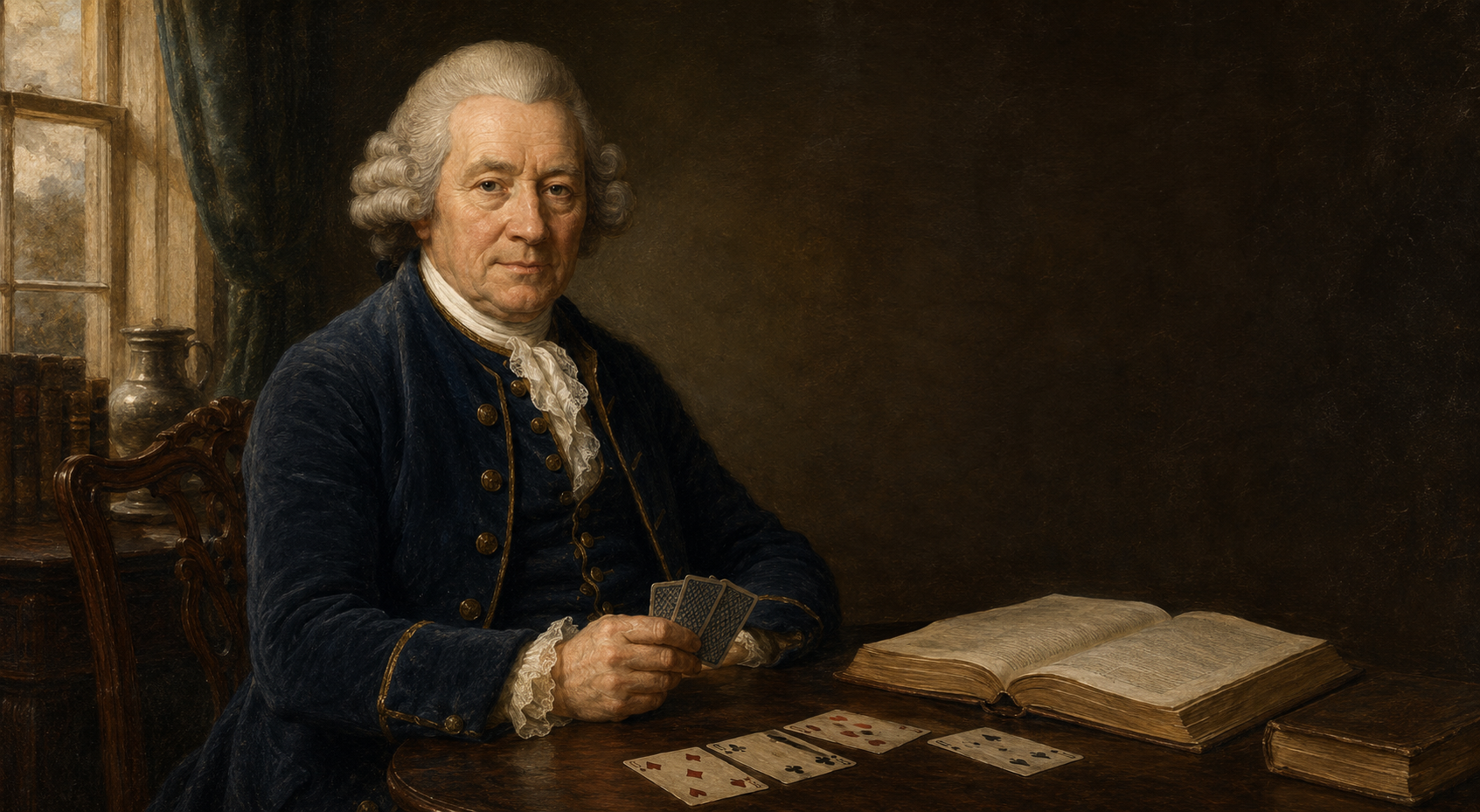
Every August 29, card players have a particularly appropriate reason to settle disagreements by the book. According to Hoyle Day honors Edmond Hoyle, the eighteenth-century writer whose rules and strategy books became so authoritative that his name entered the English language.
It is also a meaningful date for ClassicDecks. We opened on According to Hoyle Day in 2025, making August 29, 2026, our first anniversary. The connection was deliberate: Hoyle represents the idea that playing cards deserve knowledge, history, and rules that players can trust.
Why Is According to Hoyle Day on August 29?
According to Hoyle Day is observed on August 29 because Edmond Hoyle died on that date in 1769. He was about 97 years old—an extraordinary age for the eighteenth century.
The person or organization that first created the modern observance is not reliably known. Some websites repeat more specific origin stories, but no strong primary source has surfaced to establish one.
What is clear is the reason for the date: August 29 commemorates Hoyle and the authority his name came to represent.
Who Was Edmond Hoyle?
Surprisingly little is known about Hoyle’s early life. He was born in England in 1672, but most of his documented public story begins when he was already nearly 70.
By 1741, Hoyle was teaching fashionable London players the game of Whist and providing his pupils with handwritten notes explaining the game.
Those notes became A Short Treatise on the Game of Whist, published in November 1742. Hoyle initially sold the book privately for the remarkable price of one guinea.
It was not simply a list of rules. The book addressed strategy, probability, difficult situations, and the reasoning behind good play. In that sense, Hoyle helped establish a new kind of publication: a serious, analytical guide to a popular game.
The book was valuable enough to attract pirates almost immediately. Unauthorized printers issued cheaper copies, forcing Hoyle and his publisher to compete with them. Genuine editions were eventually distinguished by Hoyle’s own signature—an eighteenth-century form of authentication created by a copyright fight.
Hoyle later wrote about backgammon, piquet, chess, quadrille, brag, and probability. His original writings covered far fewer games than the later rule books carrying the Hoyle name, but his reputation became so durable that “Hoyle” eventually functioned almost as a synonym for an authoritative book of rules.
How “According to Hoyle” Entered the Language
Hoyle’s rules for Whist were treated as a standard authority for more than a century. At the card table, a player could settle a disputed point by appealing to what Hoyle had written.
To play “according to Hoyle” was to play correctly and in accordance with the accepted rules.
The expression eventually moved beyond games. Today, “according to Hoyle” can mean that something has been done properly, by established procedure, or in full compliance with accepted practice. Even people who have never played Whist recognize the phrase.
What Is Whist?
Whist is a four-player partnership trick-taking game and one of the great ancestors of modern Bridge. It developed from earlier English games, became fashionable during the eighteenth century, and crossed the Atlantic early enough to be played in taverns and military camps during the American Revolution.
The rules are much simpler than Bridge because there is no auction or bidding system. The challenge comes from memory, inference, partnership play, and deciding when to lead or preserve strong cards.
How to Play a Beginner Game of Whist
Players and partners: Four people play in two partnerships. Partners sit opposite one another.
The deal: Use a standard 52-card deck. Deal all 13 cards to each player.
Trump: Traditionally, the dealer’s last card is turned face up before being taken into the dealer’s hand. Its suit becomes trump for that deal.
The opening lead: The player to the dealer’s left leads any card.
Following suit: Each player must follow the suit led when able. A player who cannot follow suit may play any card, including a trump.
Winning a trick: The highest trump wins the trick. If no trump is played, the highest card of the suit led wins. Aces are high.
Continuing play: The player who wins a trick leads the next one. A complete deal contains 13 tricks.
Simple scoring: Each partnership scores one point for every trick it wins beyond the first six. Eight tricks, for example, score two points. For an easy home game, the first partnership to five points wins.
Traditional Whist has additional conventions and historical scoring variations, including rules involving honors. Beginners can leave those aside and still experience the central game Hoyle helped make famous.
Whist in the United States
Whist became a major American social and competitive game during the nineteenth century. The American Whist League was founded in 1891, at the same time that duplicate methods were making it possible for clubs to compare skill while reducing the influence of luck in the deal.
The League flourished for roughly four decades, but Bridge gradually displaced traditional Whist.
Traditional Whist no longer has the large national club system it once did. Today, players looking for an organized game are more likely to find Bridge, Bid Whist, or a general card-game group.
Bid Whist—a distinct American member of the Whist family with bidding and other rule differences—remains especially active in clubs and social groups across the United States.
For players who want to begin, the Museum of the American Revolution offers printable Whist instructions, while Meetup lists current Bid Whist groups. Local libraries, senior centers, community centers, and general card clubs are also worth checking.
Because classic Whist needs only four people and an ordinary deck, starting a table of your own may be the easiest route.
Celebrate According to Hoyle Day
The best way to mark According to Hoyle Day is simple: gather four players, deal 13 cards apiece, turn the last card for trump, and try a game of Whist.
It takes only a few minutes to learn, but its partnership strategy explains why the game held players’ attention for centuries.
And if a question arises at the table, there is only one proper way to settle it: according to Hoyle.
ClassicDecks Turns One
ClassicDecks opened on According to Hoyle Day 2025. To celebrate our first anniversary, we are featuring four playing-card specials over five days:
- Wednesday, August 26: Bicycle Mini Playing Cards — $5, regularly $9.99
- Thursday, August 27: Congress Gardens Playing Cards — $5, regularly $9.99
- Friday, August 28: 2001 Cincinnati-Printed Maverick Playing Cards — $4.50, regularly $8.99
- Saturday, August 29: Hoyle Shell Back Bridge-Size Playing Cards — $4, regularly $7.99
- Each deck will be available at its special price on its featured day. On Sunday, August 30, all four specials return together for one final Anniversary Encore.
All anniversary prices apply automatically and are available while supplies last.