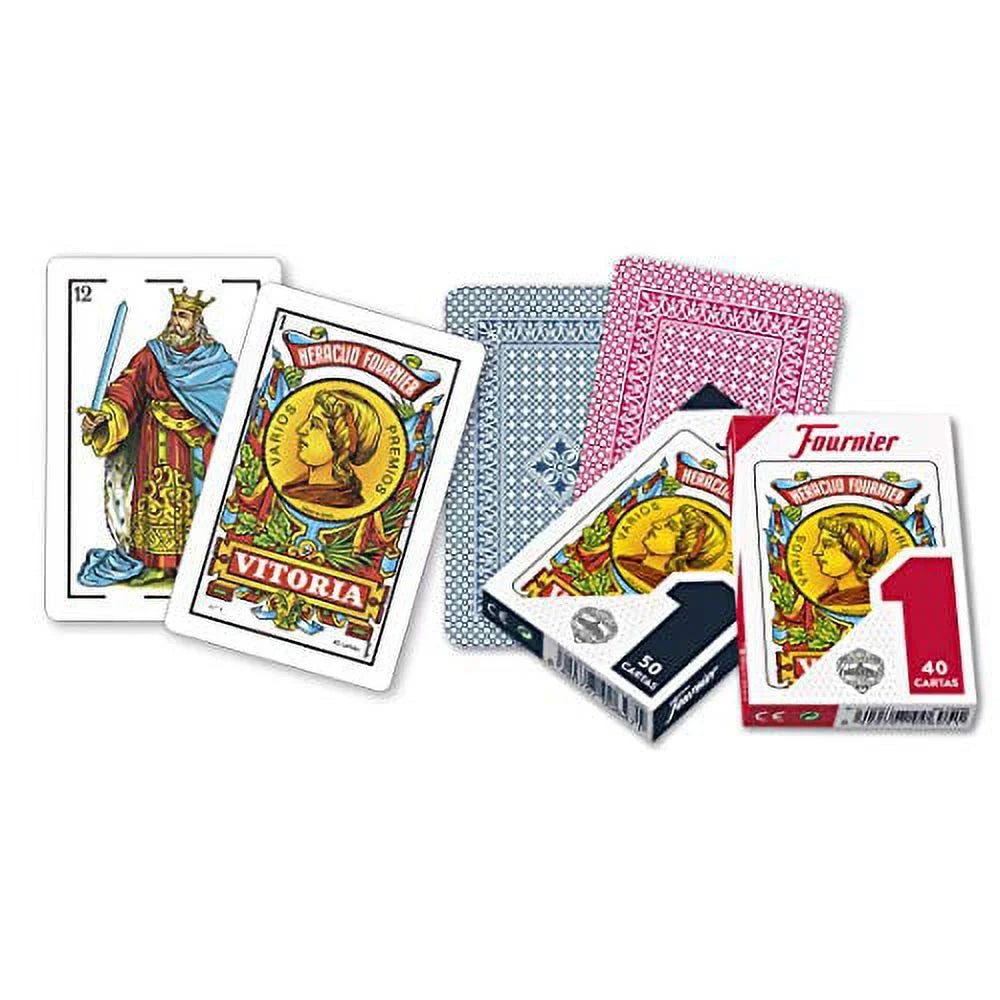
If you’ve only played with standard poker decks, Spanish playing cards open the door to a different and very old card-playing tradition. At ClassicDecks, we carry Heraclio Fournier Spanish playing cards, a traditional Spanish baraja used for classic games like Mus, Brisca, and Tute.
These decks use the traditional Spanish suits of bastos, oros, copas, and espadas rather than clubs, diamonds, hearts, and spades. That makes them a great choice for anyone who wants to explore a different card tradition, learn classic Spanish games, or add something distinctive to game night.
Our current Fournier selection includes the Heraclio Fournier No. 1 Spanish Playing Cards – Red & Blue Traditional Baraja and the Heraclio Fournier No. 1 Spanish Playing Cards – 1/2 Brick (6 Decks) Red & Blue Mix.
What Is a Spanish Deck?
A traditional Spanish deck, or baraja española, differs from the standard French-suited deck most players in the United States know best. Instead of hearts, diamonds, clubs, and spades, a Spanish deck uses:
- Oros (coins)
- Copas (cups)
- Espadas (swords)
- Bastos (clubs or batons)
The Fournier No. 1 deck sold at ClassicDecks is a traditional 40-card Spanish deck. Once you get used to the different suits and card order, it opens up a wide range of classic games that feel very different from standard poker, rummy, or bridge.
Mus
Mus is one of the best-known Spanish card games and is especially popular as a partnership game. It is usually played by four players in two teams, with partners sitting opposite each other.
Unlike many familiar card games, Mus is not mainly about taking tricks. It is a betting and hand-comparison game built around several stages of play. Players compare their hands in categories such as the highest hand, the lowest hand, pairs, and game-value combinations. Bluffing, partnership awareness, memory, and table feel all matter.
How Mus Works
- Four players sit as two partnerships.
- Each player receives four cards.
- Players decide whether to keep their hands or exchange cards. If everyone agrees, cards can be discarded and replaced.
- Once the hands are set, players compare and bet across the main categories of the game.
- The partnership that wins enough scoring units wins the game.
Mus is often considered the deepest of these three games. If you enjoy partnership play, bluffing, and reading the table, Mus is a great game to learn.
Brisca
Brisca is one of the easiest traditional Spanish games to learn and a great place to start with a Spanish deck. It is a trick-taking game built around point cards and a trump suit.
The goal in Brisca is not simply to win the most tricks. Instead, the aim is to win the tricks that contain the most valuable cards. Certain cards are worth more points than others, so timing and trump management are important.
How Brisca Works
- Use a 40-card Spanish deck.
- Deal three cards to each player.
- Turn the next card face up to establish the trump suit.
- Players each play one card to each trick.
- The winner of the trick takes the cards, and players draw from the stock until the stock runs out.
- At the end, players count points from the cards they have won.
Brisca is a strong introduction to Spanish cards because it is easy to teach, quick to play, and rewarding without being overly complicated.
Tute
Tute is another classic Spanish game, and it builds naturally on the trick-taking style of Brisca. It is usually played as a partnership game and adds extra layers through declarations and bonus scoring.
Like Brisca, Tute uses a trump suit and focuses on capturing valuable cards. What makes it different is that players may also score through certain combinations, depending on the version being played.
How Tute Works
- Use a 40-card Spanish deck.
- A common version uses four players in two partnerships.
- Each player receives ten cards.
- A trump suit is established.
- Players play out the hand by taking tricks.
- Declarations and captured cards are used to determine the final score.
Tute is a good next step after Brisca. It still feels approachable if you already know trick-taking games, but it adds a little more depth and strategy.
Which Game Should You Learn First?
If you are completely new to Spanish playing cards, Brisca is probably the best place to begin. It teaches the deck naturally and is easy to introduce at the table. Tute is a good second game once you are comfortable with the deck and want a little more depth. Mus is the most distinctive of the three and is especially appealing for players who enjoy partnership dynamics, bluffing, and betting structure.
Try Traditional Spanish Cards at ClassicDecks
If you want to experience these games the right way, using a real Spanish baraja makes a difference. Explore our Fournier collection to shop traditional Spanish playing cards made for Mus, Brisca, Tute, and more.
You can start with the Heraclio Fournier No. 1 Spanish Playing Cards – Red & Blue Traditional Baraja or stock up with the 1/2 Brick (6 Decks) Red & Blue Mix.
For anyone looking to try something different for game night, Spanish playing cards are a fun and rewarding place to start.