

Description
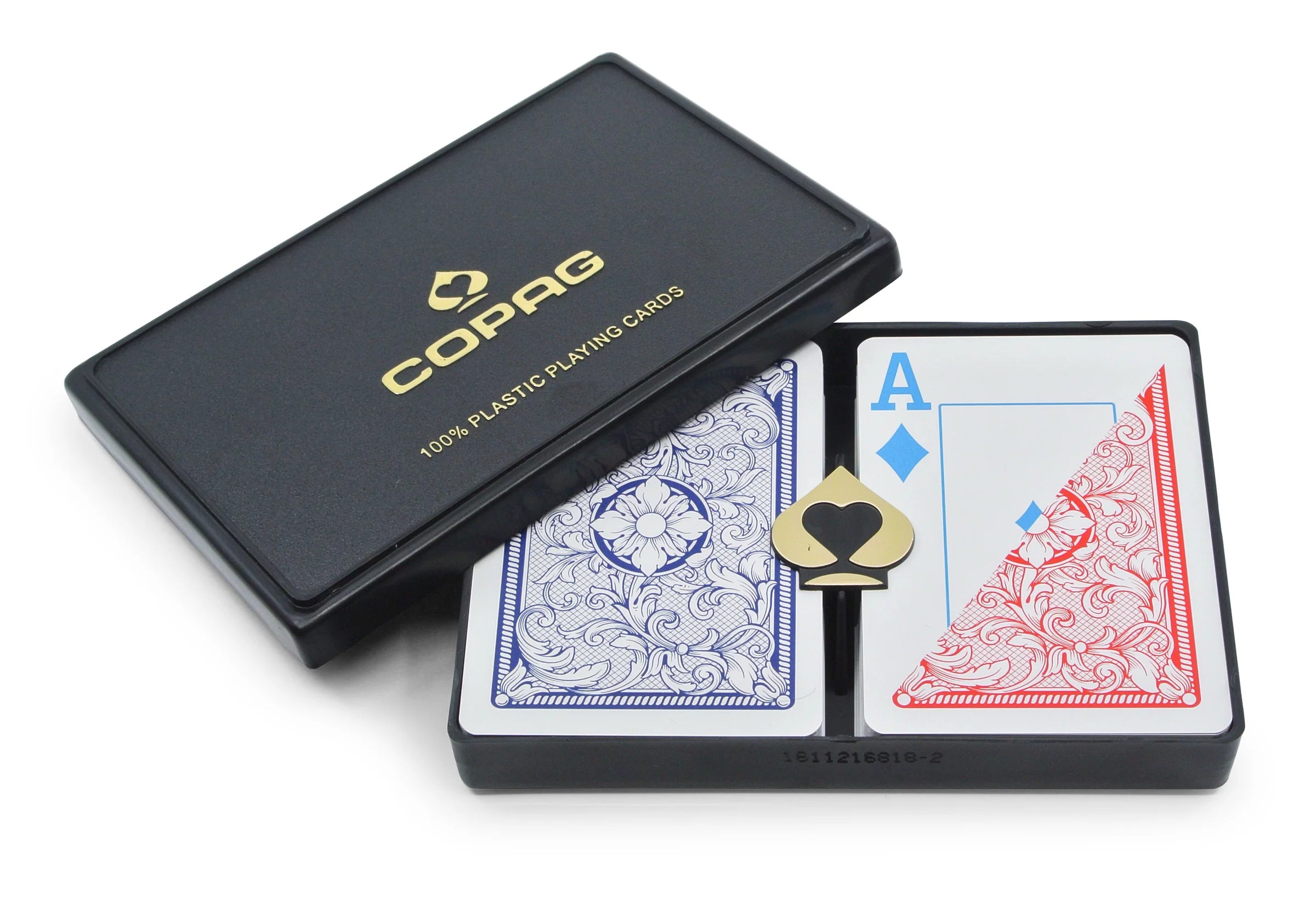
The Copag Legacy 4-Color Poker Size Jumbo Index Playing Cards represent a deliberate cognitive optimization—an innovation that challenges century-old conventions about how suits should be distinguished. While professional poker environments maintain institutional attachment to traditional two-color systems, home game players, serious enthusiasts, and players seeking genuine advantages have increasingly embraced four-color decks as the superior strategic choice. The Copag Legacy 4-Color deck transforms a simple color variation into a meaningful reduction of the most common card identification errors in poker gameplay.
The Four-Color Breakthrough: Strategic Clarity Over Convention
In traditional playing cards, hearts and diamonds are both red—distinguished only by their pip symbols and player attention to detail. Clubs and spades are both black, again requiring symbol recognition to differentiate. This two-color system originated centuries ago when card manufacturing limitations made four-color production impractical. Those limitations vanished generations ago, yet institutional gaming environments maintained the two-color standard for reasons of tradition and anti-cheating protocol.
The four-color system reimagines suit distinction: hearts remain red, spades remain black, but clubs become green and diamonds become blue. This seemingly simple change delivers profound cognitive advantages. When a flush draw appears on the board, you instantly recognize whether diamonds are green or blue. You've eliminated the most common flush-related misread in poker—confusing a heart for a diamond or a club for a spade. This advantage compounds across hundreds of hands.
Online poker platforms adopted four-color decks years ago precisely because they enable faster, more accurate hand recognition. Professional players training for major events increasingly use four-color decks at home, then transition to traditional formats for tournament play. The cognitive investment in training with four-color decks—learning to process color-based suit distinction—transfers immediately to tournament environments despite the visual format change.
Why Four-Color Reduces the Most Common Poker Error
A flush-related misread typically occurs when you quickly assess the board and misidentify a suit. A flash of red could be a heart or diamond. In split-second decision-making, these errors cascade. With four-color suits:
- A flash of blue is definitively a diamond (for your flush requirements)
- A flash of green is definitively a club
- You eliminate the cognitive delay of reconciling suit symbol with color
- Your hand analysis accelerates because suit recognition becomes automatic rather than requiring attention
This advantage proves particularly valuable in games with multiple draws and rapid calculation requirements—specifically games like Omaha (where you're managing multiple suit combinations) and mixed games (where attention allocation matters tremendously).
Why Casinos Don't Use Four-Color: Anti-Cheating Philosophy
Professional casinos and poker rooms maintain deliberate institutional resistance to four-color decks. The logic is anti-intuitive but logically sound: if card flashes (accidental exposure during dealing or handling) become too informative, players gain unintended information advantage. A flash of blue diamond tells you precisely what suit exposed, whereas a flash of red diamonds leaves ambiguity about whether it was hearts or diamonds.
This anti-cheating philosophy assumes that information restriction improves security. By maintaining ambiguous color identification, casinos reduce the value of accidentally exposed cards. This reasoning makes sense in professional environments where security protocols prioritize eliminating every potential vulnerability.
Yet this same logic doesn't apply to home games where the primary concern is gameplay accuracy rather than security theater. Four-color decks belong in environments where you're playing poker with friends rather than competing against motivated information-gatherers.
100% Plastic, Copag Quality: The Standard You Expect
Copag Legacy 4-Color decks feature identical 100% PVC plastic construction as all Copag professional formats. The four-color distinction creates no compromise to durability, washability, or long-term performance. These are genuine Copag cards that happen to feature the enhanced color system—not novelty decks or experimental formats.
The plastic construction means:
- Waterproof immunity to beverage exposure
- Mark-resistance that prevents cheating through physical card alteration
- Longevity outlasting paper-based competitors by up to 50 times
- Washability that maintains pristine appearance indefinitely
- Consistency across hundreds of hands without handling degradation
Jumbo Index: Maximum Clarity on Top of Color Advantage
The jumbo index (enlarged pips) amplifies the four-color advantage. When you quickly scan your hole cards or assess the board, both color distinction and enlarged pip visibility combine to accelerate hand assessment. You've optimized two independent variables simultaneously—suit color clarity plus pip visibility.
This combination proves particularly valuable in games where hand assessment speed matters. In Omaha, you're reading multiple suit combinations rapidly. Jumbo index combined with four-color pips accelerates that process without sacrificing the accuracy that careful hand evaluation requires.
The Growing Recognition of Four-Color Superiority
Four-color deck adoption has accelerated significantly over the past decade. Online poker platforms standardized four-color systems. Serious home game players increasingly recognize that four-color decks improve gameplay accuracy and reduce frustration from misreads. Players training for major events often begin sessions with four-color decks before transitioning to traditional formats for tournament familiarity.
This represents a philosophical shift: the recognition that institutional convention should yield to cognitive optimization when consequences don't include security vulnerabilities. Home games don't require the anti-cheating paranoia that drives casino preference for traditional systems.
Perfect For:
- Serious home game players seeking cognitive optimization and reduced misreads
- Omaha and mixed-game enthusiasts managing multiple suit combinations
- Players training with four-color decks who appreciate Copag's durability
- Anyone experiencing frequent flush misreads who recognizes the solution
- Players transitioning from online poker who prefer four-color familiarity
- Collectors documenting modern innovations in playing card design
- Anyone seeking genuine gameplay advantage through thoughtful format selection
The Intelligent Choice for Optimized Home Gaming
Copag Legacy 4-Color represents a calculated departure from institutional convention in pursuit of genuine cognitive advantage. It acknowledges that casinos maintain two-color systems for security-theater reasons irrelevant to home gaming. It recognizes that online poker standardized four-color systems because they demonstrably improve gameplay accuracy. And it delivers those advantages through Copag's proven durability and quality.
When you choose Copag Legacy 4-Color, you're making a statement about your approach to poker: you prioritize gameplay optimization over institutional tradition. You've recognized that the most common errors in poker—flush misreads—have a clear solution. You've invested in the format that serious online players use. You've chosen cognitive clarity over arbitrary convention.
For home game players, serious enthusiasts, and anyone seeking the competitive advantage that comes from eliminating the most common card-identification errors, Copag Legacy 4-Color Poker Size Jumbo Index delivers both the durability of professional-grade plastic and the strategic sophistication of a format designed to optimize human cognition.


